
Introduction
Khan Krum stands among the most powerful and influential rulers in early medieval Europe. Reigning from 803 to 814 AD, he transformed Bulgaria from a developing state into a dominant regional power. His leadership combined military brilliance with strict legal reform, proving that true strength lies not only in conquest, but in order and governance.
Rise to Power
Krum ascended the throne during a time of instability. Bulgaria faced both internal fragmentation and constant pressure from the Byzantine Empire. Through decisive leadership, he unified tribes and strengthened central authority, preparing the state for expansion and resilience.
Expansion and Military Success
One of Krum’s earliest achievements was the destruction of the Avar Khaganate, which opened vast territories to Bulgarian control. This victory significantly increased Bulgaria’s influence in Central and Eastern Europe.
His most famous triumph came in 811 AD, when he defeated and killed Emperor Nikephoros I at the Battle of Pliska. The death of a reigning Byzantine emperor on the battlefield was unprecedented and sent shockwaves throughout the medieval world.
The Laws of Krum — Building a State
Khan Krum’s legal reforms are among the earliest known in Bulgarian history. Although the original written code has not survived, his laws are preserved through Byzantine sources such as the Suda and the writings of Constantine VII Porphyrogenitus.
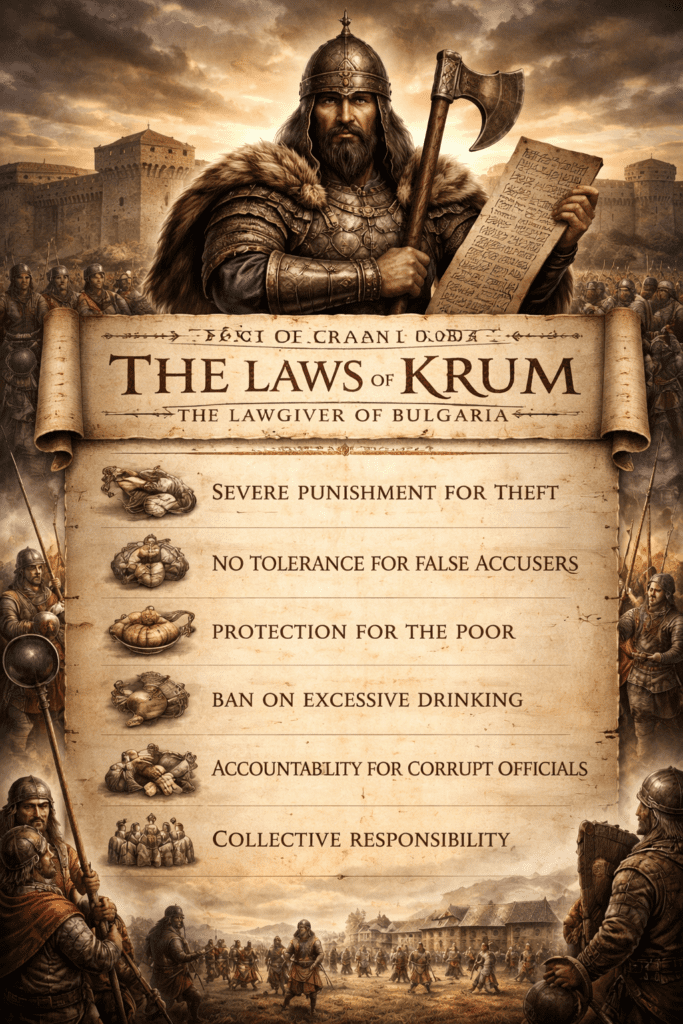
Key Laws with Historical Context
Severe punishment for theft
“If anyone accuses another of theft, he shall not be heard until he is bound; and if the accusation proves false, the accuser shall be put to death.”
— based on the Suda
No tolerance for false accusations
“Let no one bring an accusation lightly; for false accusers shall suffer the punishment they intended for others.”
Protection for the poor
“Let the poor be sustained, that there be no beggars in the land.”
Measures against drunkenness
“He ordered the vineyards to be cut down, so that drunkenness might cease among the people.”
— Constantine VII Porphyrogenitus
Punishment for corruption
“Those who take bribes shall be punished without mercy.”
Collective responsibility
“If a crime is committed, the whole community shall answer for it.”
Why His Laws Mattered
Krum’s laws played a crucial role in transforming Bulgaria from a loose tribal union into a structured and centralised state. By enforcing discipline, reducing internal conflict, and strengthening authority, they allowed Bulgaria to grow into a major power.
Strengthening the Capital
Krum fortified Pliska, turning it into a strong political and military centre. Its massive walls symbolised the stability and strength of his rule.
Legacy
Khan Krum’s reign marked a turning point in Bulgarian history. His combination of military success and legal reform laid the groundwork for future rulers such as Tsar Simeon the Great, under whom Bulgaria would reach its cultural and territorial peak.
Conclusion
Khan Krum was more than a conqueror—he was a lawgiver and state-builder. His legacy lies in the balance he achieved between strength and order. Through discipline, justice, and vision, he transformed Bulgaria into a respected and formidable power in medieval Europe.
Хан Крум — законодателят и владетелят, който изгради България
Въведение
Khan Krum е един от най-силните и значими владетели в ранносредновековна Европа. Управлявайки между 803 и 814 г., той превръща България от развиваща се държава в доминираща сила. Неговото управление съчетава военен гений и строги закони, доказвайки, че истинската мощ идва не само от завоеванията, но и от реда.
Възход към властта
Крум се възкачва на престола в период на нестабилност. България е под натиск от Византийската империя, а вътрешно е разпокъсана. Чрез решителни действия той обединява племената и укрепва централната власт.
Разширение и военни успехи
Едно от първите му постижения е разгромът на Аварския хаганат, което отваря нови територии за България.
През 811 г. той постига знаменита победа, като разбива и убива император Никифор I Геник при битката при Плиска — събитие с огромен отзвук в Европа.
Законите на Крум — основа на държавността
Законите на Крум са едни от първите известни в българската история. Те достигат до нас чрез византийски източници като „Суда“ и трудовете на Константин VII Багренородни.
Основни закони с исторически контекст
Строги наказания за кражба
„Ако някой обвини друг в кражба, нека бъде вързан; ако обвинението е лъжливо — обвинителят да бъде наказан със смърт.“
Без толеранс към лъжливи обвинения
„Никой да не обвинява лекомислено; лъжливите обвинители да понесат наказанието, което са искали за другите.“
Закрила на бедните
„Бедните да бъдат подпомагани, за да няма просяци в държавата.“
Ограничаване на пиянството
„Заповядал да се изсекат лозята, за да се прекрати пиянството сред народа.“
— Константин VII Багренородни
Наказания за корупция
„Тези, които вземат подкупи, да бъдат наказвани без пощада.“
Колективна отговорност
„Ако бъде извършено престъпление, цялата общност да отговаря за него.“
Значение на законите
Законите на Крум превръщат България в централизирана и добре организирана държава. Те намаляват престъпността и укрепват властта.
Укрепване на столицата
Крум укрепява Плиска и я превръща в силен държавен център.
Наследство
Неговото управление поставя основите за владетели като Цар Симеон Велики, при които България достига своя разцвет.
Заключение
Хан Крум не е просто завоевател — той е законодател и държавник. Чрез ред и сила той изгражда основите на могъща България.