Bulgaria – The Hidden Crossroads of Civilisations
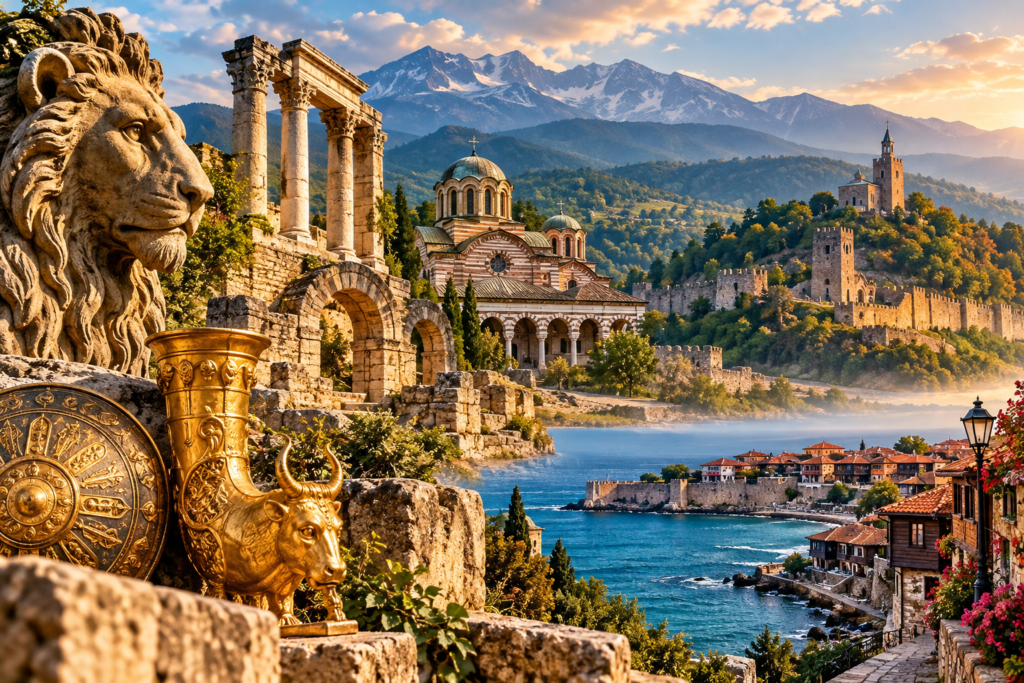
Bulgaria sits at a unique geographical and cultural intersection between Europe and Asia. Over thousands of years, it has been shaped by Thracians, Greeks, Romans, Slavs, and Bulgars—each leaving a lasting imprint on the land and its people.
While the world flocks to the ruins of Rome or the pyramids of Egypt, a quieter, equally ancient story is etched into the landscape of the Balkans. Bulgaria is not just a destination; it is a geographic laboratory where the layers of human history are stacked so densely that a subway expansion in the capital often turns into a major archaeological rescue mission.
From the world’s oldest processed gold to the birthplace of the Cyrillic script, Bulgaria sits at the literal and figurative crossroads of East and West.
1. Prehistoric Pioneers: The Varna Gold
Long before the first stone was laid for the Great Pyramid of Giza, a sophisticated culture thrived on the shores of the Black Sea. In 1972, workers accidentally uncovered the Varna Necropolis, dating back to 4600–4200 BC.
- The Discovery: Over 3,000 gold artifacts were found, representing the oldest processed gold in the world.
- The Significance: This wasn’t just shiny jewelry; it was evidence of a highly organized society with complex social hierarchies and trade networks that stretched across the ancient world centuries before the rise of Mesopotamia.
2. The Mystical Thracians: Kings of the Valley
The Thracians were the „barbarian“ elite of the ancient world—fierce warriors and master goldsmiths mentioned by Homer in the Iliad. They left no written records, but their monumental tombs speak volumes.
- The Valley of the Thracian Kings: Located near Kazanlak, this area is home to hundreds of burial mounds.
- UNESCO Treasures: The Thracian Tomb of Kazanlak (4th century BC) features breathtaking frescoes of funeral feasts and chariot races, offering a rare, colorful window into a culture that deeply influenced Greek mythology and Roman warfare.
3. Rome in the Balkans: Trimontium and Serdica
When the Roman Empire expanded, they didn’t just conquer Bulgaria; they built upon its foundations. Plovdiv, one of the oldest continuously inhabited cities in the world, became the Roman jewel known as Trimontium.
- Plovdiv’s Roman Theatre: Built in the 2nd century AD under Emperor Trajan, it is still used today for opera and theater, seating 5,000 people against the backdrop of the Rhodope Mountains.
- Serdica (Sofia): Emperor Constantine the Great so loved the hot springs and strategic location of modern-day Sofia that he famously said, „Serdica is my Rome.“ Today, you can walk through the ruins of the Roman city right inside the Sofia Metro stations.
4. The Medieval Might: A Cultural Conduit
During the Middle Ages, Bulgaria rose as a superpower that challenged the Byzantine Empire. This „Golden Age“ was defined not just by territory, but by an intellectual revolution.
- The Cyrillic Script: In the 9th century, the Bulgarian Empire became the cradle of Slavic literacy. The development of the Cyrillic alphabet here provided a spiritual and cultural identity for millions across Eastern Europe and Asia.
- Tsarevets Fortress: In Veliko Tarnovo, the „City of Tsars,“ the massive walls of the Second Bulgarian Empire still stand, guarding a history of patriarchs and emperors who once ruled from the Black Sea to the Adriatic.
The Modern Crossroads
Bulgaria remains a place where you can start your morning at a Neolithic dwelling, have lunch in a Roman amphitheater, and spend your evening in a medieval fortress. It is a land that doesn’t just display history—it lives within it.
Traveler’s Tip: If you visit the Rila Monastery (Bulgaria’s largest), look for the intricate wood-carved „Rafail’s Cross.“ It took a monk 12 years to carve 104 religious scenes and 650 miniature figures into a piece of wood—a testament to the patience and spiritual depth of this enduring crossroads.
Whether you are drawn by the rugged Balkan peaks or the golden sands of the Black Sea, look beneath the surface. You’ll find a civilization that was here first, waiting to be rediscovered.
This is most evident in cities such as Plovdiv, where ancient and modern coexist naturally. A Roman theatre stands alongside Ottoman-era houses and Bulgarian Revival architecture, creating a living narrative rather than a preserved exhibit.
Bulgaria’s position as a crossroads has also shaped its mentality. It has learned to adapt, absorb, and endure. This has resulted in a culture that is both deeply rooted and quietly resilient.
Unlike many parts of Europe where history feels distant or curated, in Bulgaria it remains part of everyday life. Traditions, architecture, and cultural memory are not separated from the present—they are integrated within it.
This continuity gives Bulgaria a distinctive character. It is not simply a place shaped by history, but one that continues to live through it.
Explore Further (Official Links)
To dive deeper into the history or plan your trip, use these official resources:
- Official Tourism Portal of Bulgaria: The comprehensive guide for regional travel, culture, and nature.
- UNESCO World Heritage – Bulgaria: Detailed architectural and historical dossiers on Bulgaria’s protected world sites.
- Varna Archaeological Museum: The home of the world’s oldest gold and prehistoric artifacts.
- Ancient Plovdiv Municipal Institute: Information on the Roman Theatre, Stadium, and the colorful Old Town houses.
- Rila Monastery Official Site: Visiting hours, history, and museum details for the spiritual heart of the Balkans.
💡 Quick Travel Tip
If you’re visiting Sofia, don’t miss the Largo (between the Presidency and the Council of Ministers). It’s a free, open-air museum where you can walk on original Roman streets while looking up at the capital’s modern skyline—the ultimate „crossroads“ experience.