
John Atanasoff: The Bulgarian-American Who Built the First Electronic Digital Computer | Джон Атанасов
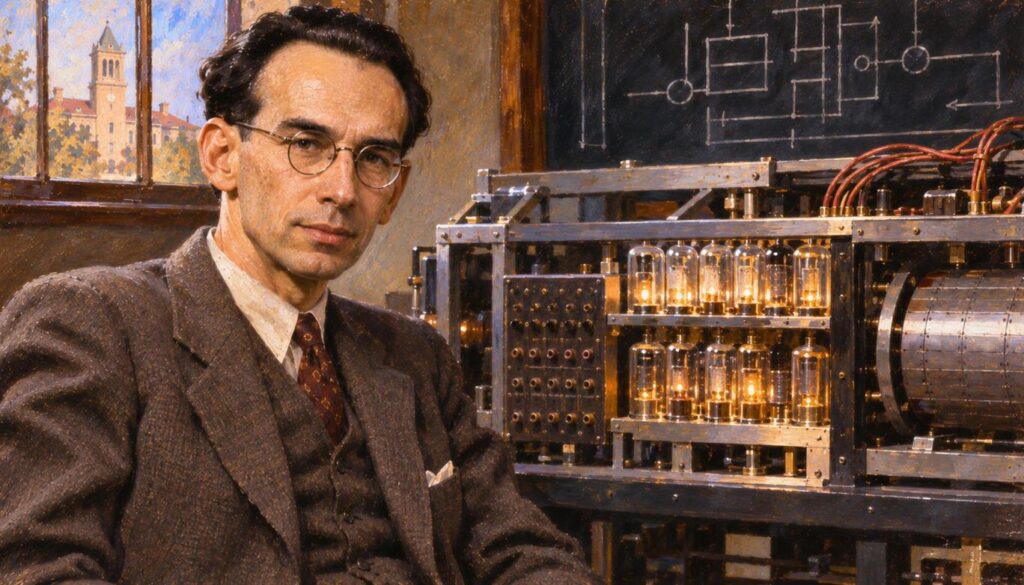
If you are reading this on a phone or laptop, you are using an idea that a man with Bulgarian roots worked out on a cold night in 1937. John Vincent Atanasoff (Джон Атанасов, 1903–1995) designed the first electronic digital computer.
A Bulgarian family story
His father, Ivan Atanasov, was born in the village of Boyadzhik near Yambol and emigrated to the United States as a boy. John was born in New York State in 1903 and grew up loving mathematics. He became a professor of physics and mathematics at Iowa State College, where his students spent weeks solving long equations by hand.
The Atanasoff–Berry Computer
Frustrated by slow mechanical calculators, Atanasoff decided a machine should do the work electronically. Together with his graduate student Clifford Berry, he built the Atanasoff–Berry Computer (ABC) between 1939 and 1942. It introduced ideas every computer still uses:

- Binary numbers (ones and zeros) instead of decimals
- Electronic switching with vacuum tubes instead of moving parts
- Regenerative memory on capacitors, the ancestor of today’s RAM
- Separating memory from computing
Recognised in court
For years the American ENIAC was called the first computer. In 1973 a US federal court ruled in the case Honeywell v. Sperry Rand that the ENIAC patent was invalid, because its key ideas came from Atanasoff’s work. In 1990 he received the US National Medal of Technology and Innovation.
His bond with Bulgaria
Atanasoff visited Bulgaria in 1970 and was awarded the Order of Saints Cyril and Methodius. Today schools, a street in Sofia and the Bulgarian computer science award all carry his name, and Bulgarians proudly call him the father of the computer.
More from this series: Famous Bulgarians and their gifts to the world
Top image: AI-generated illustration, not a photograph.