
Georgi Nadjakov: The Bulgarian Physicist Behind the Photocopier | Георги Наджаков
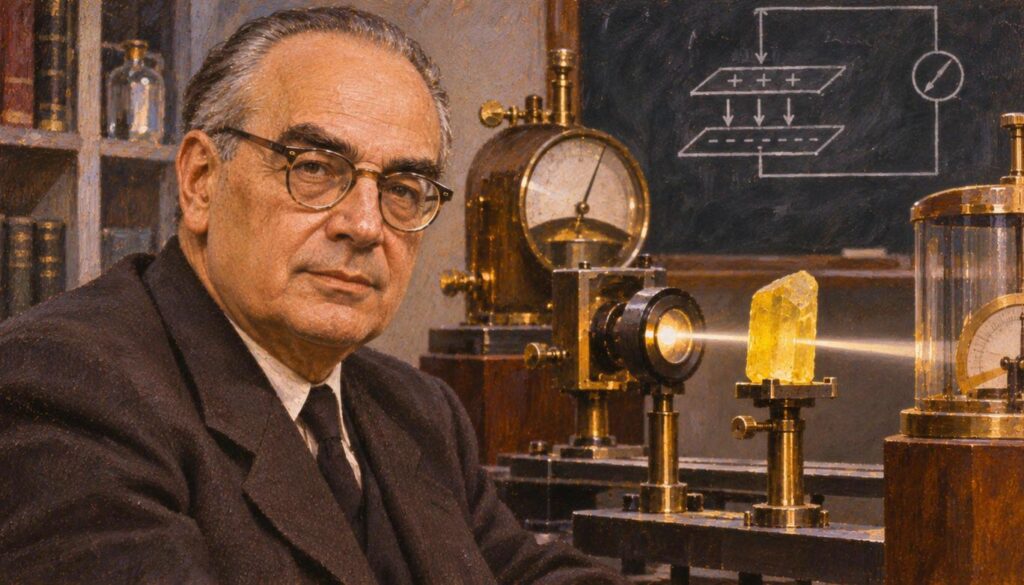
Every time you photocopy a document or print on a laser printer, you use science that a Bulgarian discovered. Georgi Nadjakov (Георги Наджаков, 1897–1981) is the father of the photoelectret.
Trained in Paris
Born in Dupnitsa, Nadjakov studied physics at Sofia University. In 1925–26 he worked in Paris in the laboratories of Paul Langevin and Marie Curie, studying photoelectricity.
The 1937 discovery
Back in Sofia, while studying the photoconducting properties of sulphur, he discovered that light and an electric field together could leave a material with a lasting electric charge. He called it the photoelectret state of matter and published it in 1937 and 1938. He later said he made it with primitive equipment, but with his own idea.

Why it matters
The discovery became part of the foundation for electrophotography, the method behind photocopiers and laser printers that Chester Carlson developed in the United States. It is regarded as the first internationally recognised scientific discovery made in Bulgaria, and his name is the first in Bulgaria’s Golden Book of Discoverers and Inventors.
His legacy
- Founder of the Institute of Physics at the Bulgarian Academy of Sciences (1946)
- Rector of Sofia University
- His study is a Historic Site of the European Physical Society (2014)
- Nadjakov Glacier in Antarctica carries his name
More from this series: Famous Bulgarians and their gifts to the world
Top image: AI-generated illustration, not a photograph.